A TreeKings' History Lesson


To truly understand a tree, you must first understand its history. And a tree's history is a combination of the land history, the settlers history, government history and so much more.
All land was once untouched. Trees once grew naturally, with no assistance or interference from anyone but mother nature. Canada remained largely unaltered until Jacque Cartier came to what is now Quebec via the St. Lawrence River in 1535. Soon after “Upper Canada” became popular for immigration and the vast forests were what made this land unique. As central Ontario became more and more popular to settlers, more land was needed to support the growing population. The resulting land development introduced human interfaces to the trees that were here (i.e. settlements, towns, infrastructure, roads, etc.). Most settlements began near major coast lines for ease of import and export, creating the major cities we know today, such as the Greater Toronto Area, Ottawa and Montreal and Quebec.
By the 1800s, Governments had developed much of southern Ontario, and began to explore northern land for future development. Now remember, this was a time before roads, before cars and trucks and machinery. Development of settlements and surveying of land took brave individuals, strong families, supportive communities, and a lot of hard work.
In 1820 surveyors ventured north up the Gull River from Balsam Lake and the Burnt River. It did not take long for travelers to note the rough terrain and a “circulatory system of lakes and streams”. Valleys were noted to have good soil for beech, maple, birch and elm, while the northern ridges were home to pines so big they put today's large pines to shame.

By 1850, colonization roads such as Bobcaygeon, Peterson and Buckhorn roads were in the works and land grants from the Department of Agriculture were being distributed. The first advertised land sale for Minden was put into the Canadian Gazette newspaper in July 1859 and by December 1859, 25 lots had sold. At that time, the land throughout the area we now know as Haliburton Highlands was advertised as good agricultural land. It would soon be determined that the land was more suited to sportsmen and hunters, as much of the land was plagued with rock, miles of swamp and unsettle-able areas. Frost killed vegetables, rain rotted grains, cattle had to be sold due to lack of feed. The land-owners were on the brink of disaster and famine very early on due to the rugged land we have learned to love.

By 1860, there was a steady flow of pioneers into Haliburton and the surrounding regions such as Minden, Stanhope, Harburn, Fort Irwin, Dysart and Monmouth. The highlands became known as “Hinterland” or Back Country. The terrain was hilly, forests were thick and winters were long.
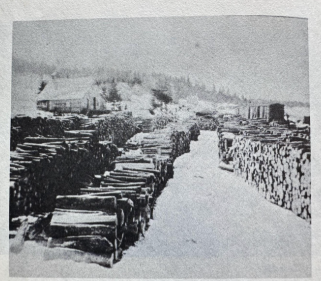
Despite the difficult living, the massive pine forests provided a glimpse of hope with the start of the logging industry. At the time, pine was considered “King” and the legendary virgin pines were expected to feed Ottawa saw mills for 600 years based on initial records. The cutting rights and planning transitioned from the Department of Agriculture to the Department of Crown Land, which really kick started the industry throughout Haliburton in 1862. Initially, men would fell logs and teams would split the massive logs with dynamite and then saw or square the timber for market. Many of the largest and finest of logs would be saved for ship masts, most notably was a log from Harburn used for the Queen’s ship.

Processed logs would be rolled to the nearest lake or river and then “run” down stream to saw mills. Log running was one of the most dangerous jobs in the logging industry as individuals would skip from log to log in the water to move them ahead or back. Log dumps were a sight to see, with hundreds of logs jamming up in dams and runners would have to risk their lives to unblock the dams and send individual logs down log slides. On average, a logging team would cut up to 75 trees per day, with 6 pieces being processed per day. By 1880, horses began replacing manpower and in 1890, “steam alligators” or high powered engine driven boats replaced horses, each expediting the process in their own right. The Logging industry in Haliburton would go on to decimate the majority of virgin pines by the early 1900s. That means that the virgin Haliburton forests would provide only 50 years of logs, not even close to the predicted 600 years.

Logging and land development were not the only ways the forests we know today evolved. A fire in 1864 would wipe out all life from the Eastern Townships to Minden, leaving nothing but burnt stumps and timber to show for the settlements. Fire has shaped land for centuries before the development of Haliburton. But, in the wake of early logging practices, there was excessive amounts of deadfall and timber left behind as waste, fueling even the smallest of forest fires. In addition, the lack of proper road ways for fire breaks and insufficient resources at the time, this record breaking fire would ravage the area, with many large burnt stumps still visible today throughout Pencil Lake where the fire began. Another noteworthy fire would break out in 1913 in Irondale, burning to Burnt River. In this instance, over 80% of mature trees were lost and the rest had to be culled.

In 1864, the region was officially “founded” and named as part of Peterborough County. The government was granting free land to settlers under the pretense that the land must be logged (under government control) for “better homesteading”. The promise of good land brought settlers from all corners of the world, such as the United States, Ireland, and England, expecting “flatter and heavily treed” land. Boy were they in for a treat…
In 1874, Haliburton County was separated from Peterborough County. At that time there were 23 separate “towns” throughout the region. Settlement was well underway, with communities growing strong, but living was still hard. The terrain made even the simplest of tasks complex. For example, from the eastern town of Tory Hill was a 2 day trip to the town of Haliburton for supplies. (For reference, the drive from Tory Hill to Haliburton in 2025 is approximately 15-20mins).

By 1890’s, the railroad(s) were coming through town! The IB&O (Irondale, Bancroft, and Ottawa) Railway connected the north-eastern communities to the south allowing for exponential growth to towns and villages along the track. The lumber and mining industries were booming. The women would homestead and teach the children, while the men worked in the lumber mills in the summer, and logged during the fall and winter.

A little to the north was the
Victoria Railway which ran over 55 miles from Lindsay to Haliburton. Logging camps were prosperous throughout the northern townships thanks to the Railway. The locomotive displayed outside the Haliburton Highlands Secondary School, CNR engine No. 2616, represents “an era in which steam was queen of the rails” and symbolizes the great impact the Canadian National Railway had on the region.
While this seems like a history of Haliburton so far, we are here to tell the TreeKings History. Well, the development of the land and the promising forests are what brought the TreeKings Ancestors to the region. So hang tight while we finish the story!

Ira and Henry Howe, TreeKing Ancestors, were known for being fearless river runners. Many river runners did not live long enough to have families of their own due to the danger of the occupation. But Ira and Henry were quick and “bred for the rapids”. Henry’s Grandson, Neil Howe, did not get to test his river running genes since the last river run took place in early 1920s, before he could take up the lifestyle. Neil was raised in Haliburton village and started working in the logging camps at the age of 14. By the time Neil was 25, he was hired by the Hodgson’s, a large logging family also from Haliburton, who had the cutting rights to the Harburn areas at the time. Neil and his wife later moved to a small self-built home neighboring the saw mill in Fort Irwin, where Neil worked for many years. In their small home they raised their family of 3 girls, one of which would later become grandmother to TreeKings Founder Austin Billings. Neil was known for hauling logs over the ice in trucks once vehicles were established. There are even photographs of Neil standing on his truck in the middle of Lake Haliburton as it sinks into the ice with a full load of logs. At least he lived to tell the tale to his grandchildren and great grandchildren!

In 1870, John and Charity Billings, more ancestors in the TreeKings Family, boarded the Star Liner from England to Quebec. After a short stint in New York and Chicago, John was drawn to the promise of Haliburton County. The Billings’ were granted land in Stanhope, where they built one of the first successful, long standing homes thanks to John’s masonry skills. These skills can be seen in the architecture of St. Peter’s Church, where Billings’ masonry mastery was said to be that of a “perfectionist”. Eventually descendants of John and Charity were granted land to the east, where they joined the thriving community of Gooderham. They were known for their tree felling abilities, handmade axe handles, and are the namesake of Billings Lake in Gooderham.

Another important side of the TreeKings Family is the Haas Family, who moved to the Haliburton area from Rochester, NY. First settling in the Stanhope area in hopes of successful logging, the land was much more rugged than they were used to, causing the original Haas' to loose any and all wealth they had brought from Rochester. In 1936, Frederick Haas and Susie Haas (Woods) were granted land on Hadlington road, north of Tory Hill, where they would build their legacy. Here they raised a big family and built a strong community throughout Monmouth. Frederick became a well known salesman for Rawleigh Company, selling health ointments via horse and buggy. In the winter months, Frederick would join logging teams as a cutter. 20 to 25 teams of loggers would start their trek from the Hadlington homestead, where many logging camps were located deep within the woods.

It became clear very quickly that the promise for “flat”, “prosperous” homesteading land was not entirely true. Haliburton County is the start of the Canadian Shield, proving to be extremely rocky and hilly, not ideal for harvesting crops and raising livestock. After the original settlers logged their first 100 granted acres, more land was offered, but often denied to avoid gaining unusable land.
Gradually, fewer men were becoming loggers or sawyers, many moving back south in hopes of jobs. But the true locals remained, watching the forests reclaim its land. The forests that were first sought after are no more. Some pockets of the region may still be home to mature, old growth forests that resemble what our ancestors logged. But, as the times changed, so did the forests. Homesteading fields and pastures have grown up to become the young, vastly mixed forests we know today. Many properties still contain the original rock fence rows used to separate homesteads, giving a glimpse into the past lives of those who came before us.

Eventually, the logging and mining industries became obsolete, causing the IB&O railway to be abandoned in 1960. Bev “Hammer” Billings, the grandfather of TreeKings founder Austin Billings, recalls riding the train on its last day of operation, as his ancestors would have done decades before him. Sections of the railway are now open as the IB&O rail trail, used as a popular recreational trail, bringing joy to locals and tourists alike.
Speaking of tourists, in the wake of the world wars and as large-scale forestry and mining began to decline, tourism began to flourish in the county. The lakes named after ancestors and pioneers became popular locations for vacationing. Hotels and Inns began to flourish, attracting travelers from all over the world. “Cottaging” became a way for families to reconnect and relax after years of stress brought on by war and depression. The way of life in the highlands was adopted by cottagers, appreciating the beautiful valleys and hills of trees and the calming essence of “lake life”.

Austin Billings grew up in Haliburton and is the founder of TreeKings. His father, Andy Billings, who also grew up in Haliburton, taught Austin everything he knew about the land and the trees here. But the wealth of knowledge does not just come from his father. Family gatherings always included shared stories of growing up amongst the forests of Haliburton from grandparents, great grandparents and great-great-grandparents, from all sides of the family tree. Austin spent many of his childhood years with Andy in the bush logging until 2008, hunting and fishing with Grandpa Bev, or learning mechanics with Great Grandpa Neil. It was a childhood very different from his ancestors who pioneered these lands, and yet in many ways not all that different. It was a childhood based on a love of the land and trees. It is that love and dedication that fueled the creation of TreeKings.

While things have changed drastically since the early 1800s, there is a way of life here in Haliburton County that draws people together. Living on the land and among the forests became a way of life passed down through the generations. The communities we know and love today are built upon the values learned “in the bush”. Hard work, comradery, appreciation for nature and trees. And these are the values that have shaped TreeKings Arboriculture Inc. into what it is today. The trees adapted along with the development of human interfaces and the trees became critical to the culture. As of today, the TreeKings family has been in Haliburton for over seven generations, and each generation had their own relationship with the trees. We do not just know trees, we know these trees because we know these lands. The history of the land is also our family history. It truly is in our blood.


Interesting read.Thank you for putting this together
Thanks for putting together this article about the history of Haliburton County and the men and women who settle it. Great job .Great read
Thank you for this article! It was an interesting and well written accounting of the history of Haliburton County in regards to trees and logging.
A nice summary of the family involvement with logging in Haliburton! Loved the old pictures.
Awesome history lesson!